util
Utilities for bpf4
| Function | Description |
|---|---|
asbpf |
Convert obj to a bpf |
binarymask |
Creates a binary mask |
blendwithceil |
Returns a blend of b with its maximum y value |
blendwithfloor |
Returns a blend of b with its minimum y value |
bpf_to_csv |
Write this bpf as a csv representation |
bpf_to_dict |
convert a bpf to a dict with the following format |
bpf_to_json |
convert this bpf to json format. |
bpf_to_yaml |
Convert this bpf to json format. |
bpfavg |
Return a Bpf which is the average of b over the range dx |
calculate_projection |
Calculate a projection needed to map the interval x0:x1 to p0:p1 |
concat_bpfs |
Concatenate these bpfs together, one after the other |
csv_to_bpf |
Read a bpf from a csv file |
dict_to_bpf |
Convert a dict to a bpf |
dumpbpf |
Dump the data of this bpf as human readable text |
histbpf |
Create a historgram of b |
jagged_band |
Create a jagged bpf between lowerbpf and upperbpf at the x values given |
loadbpf |
Load a bpf saved with dumpbpf |
makebpf |
Create a bpf from the given descriptor and points |
max_ |
Return a bpf representing the max over the given elements |
maximum |
return the x where bpf(x) is the maximum of bpf |
min_ |
Return a bpf representing the min over elements |
minimum |
Find the x where bpf(x) is minimized |
multi_parseargs |
Parse args of a multi bpf |
parseargs |
Convert the args and kws to the canonical form (xs, ys, kws) |
parsedescr |
Parse interpolation description |
projection_fixedpoint |
Returns the fixed point given the projection parameters |
randombw |
Create a random bpf |
rms |
The rms of this bpf |
rmsbpf |
Return a bpf representing the rms of the given samples as a function of time |
select |
Create a new bpf which interpolates between adjacent bpfs |
simplify_linear_coords |
Simplify the linear bpf defined by the points xs and ys |
smoothen |
Return a bpf representing a smooth version of b |
split_fragments |
Split a bpf into its fragments |
sum_ |
Return a bpf representing the sum of elements |
warped |
Represents the curvature of a linear space. |
zigzag |
Creates a curve formed of lines from b0(x) to b1(x) for each x in xs |
asbpf
def asbpf(obj, bounds: tuple = (-inf, inf)) -> core.BpfInterface
Convert obj to a bpf
Args
- obj: the object to convert to a bpf (a function, a dict, a constant or a bpf, in which case it is returned as is)
- bounds (
tuple): the lower and upper bounds where this bpf is defined (default:(-inf, inf))
Returns
(core.BpfInterface) the resulting bpf
binarymask
def binarymask(mask: str | list[int], durs: Sequence[float] = None,
               offset: float = 0.0, cycledurs: bool = True) -> core.NoInterpol
Creates a binary mask
Example
>>> mask = binarymask("x--x-x---")
Args
- mask (
str | list[int]): a mask string ('x'=1, '-'=0) or a sequence of states (a state is either 0 or 1) - durs (
Sequence[float]): a sequence of durations (default=[1]) (default:None) - offset (
float): (default:0.0) - cycledurs (
bool): (default:True)
Returns
(core.NoInterpol) A NoInterpol bpf representing the binary mask
blendwithceil
def blendwithceil(b, mix: float = 0.5) -> core._BpfBlend
Returns a blend of b with its maximum y value
Args
- b:
- mix (
float): (default:0.5)
blendwithfloor
def blendwithfloor(b: core.BpfInterface, mix: float = 0.5) -> core._BpfBlend
Returns a blend of b with its minimum y value
Args
- b (
core.BpfInterface): - mix (
float): (default:0.5)
bpf_to_csv
def bpf_to_csv(bpf: core.BpfInterface, csvfile: str) -> None
Write this bpf as a csv representation
Args
- bpf (
core.BpfInterface): the bpf to write as csv - csvfile (
str): the output filename
bpf_to_dict
def bpf_to_dict(bpf: core.BpfInterface) -> dict
convert a bpf to a dict with the following format
>>> b = bpf.expon(3.0, 0, 0, 1, 10, 2, 20)
>>> bpf_to_dict(b)
{
    'interpolation': 'expon(3.0)',
    'points': [0, 0, 1, 10, 20, 20]  # [x0, y0, x1, y1, ...]
}

>>> b = bpf.multi(0, 0, 'linear',
                  1, 10, 'expon(2)',
                  3, 25)
>>> bpf_to_dict(b)
{
    'interpolation': 'multi',
    'segments': [
        [0, 0, 'linear'],
        [1, 10, 'expon(2)',
        [3, 25, '']]
}
Args
- bpf (
core.BpfInterface): the bpf to convert to a dict
Returns
(dict) The bpf as a dictionary
bpf_to_json
def bpf_to_json(bpf: core.BpfInterface, outfile: str = None) -> str
convert this bpf to json format.
If outfile is not given, it returns a string, as in dumps
Args
- bpf (
core.BpfInterface): the bpf to dump as json - outfile (
str): the output filename. If given, output is saved here (default:None)
Returns
(str) The json text
bpf_to_yaml
def bpf_to_yaml(bpf: core.BpfInterface, outfile: str = None) -> str
Convert this bpf to json format.
Args
- bpf (
core.BpfInterface): the bpf to convert - outfile (
str): if given, the yaml text is saved to this file (default:None)
Returns
(str) The yaml text
bpfavg
def bpfavg(b: core.BpfInterface, dx: float) -> core.BpfInterface
Return a Bpf which is the average of b over the range dx
Args
- b (
core.BpfInterface): the bpf - dx (
float): the period to average b over
Returns
(core.BpfInterface) a bpf representing the average of b along the bounds of b over a sliding period of dx
calculate_projection
def calculate_projection(x0, x1, p0, p1) -> tuple[float, float, float]
Calculate a projection needed to map the interval x0:x1 to p0:p1
Args
- x0:
- x1:
- p0:
- p1:
Returns
(tuple[float, float, float]) A tuple (rx, dx, offset)
concat_bpfs
def concat_bpfs(bpfs: list[core.BpfInterface]) -> core._BpfConcat
Concatenate these bpfs together, one after the other
Args
- bpfs (
list[core.BpfInterface]):
csv_to_bpf
def csv_to_bpf(csvfile: str) -> core.BpfInterface
Read a bpf from a csv file
Args
- csvfile (
str):
dict_to_bpf
def dict_to_bpf(d: dict) -> bpf.BpfInterface
Convert a dict to a bpf
Format 1
bpf = {
    'interpolation': 'expon(2)',
    10: 0.1,
    15: 1,
    25: -1
}
Format 2
bpf = {
    'interpolation': 'linear',
    'points': [x0, y0, x1, y1, ...]
}
Format 2b
bpf = {
    'interpolation': 'linear',
    'points': [(x0, y0), (x1, y1), ...]
}
Format 3 (multi)
bpf = {
    'interpolation': 'multi',
    'segments': [
        [x0, y0, 'descr0'],
        [x1, y1, 'descr1'],
        ...
        [xn, yn, '']
    ]
}
Args
- d (
dict): the dictionary to convert to a bpf
Returns
(bpf.BpfInterface) the converted bpf
dumpbpf
def dumpbpf(bpf: core.BpfInterface, fmt: str = yaml) -> str
Dump the data of this bpf as human readable text
The bpf can then be reconstructed via loadbpf
Args
- bpf (
core.BpfInterface): the bpf to dump - fmt (
str): the format, one of 'csv', 'yaml', 'json' (default:yaml)
Returns
(str) the text representation according to the format
histbpf
def histbpf(b: core.BpfInterface, numbins: int = 20, numsamples: int = 400
            ) -> core.Linear
Create a historgram of b
Example
>>> from sndfileio import *
>>> import bpf4
>>> samples, sr = sndread("path/to/soundfile.wav")
>>> dbcurve = bpf4.util.rmsbpf(samples, sr=sr).amp2db()
>>> dbval2hist = bpf4.util.histbpf(dbcurve)
# Find the db percentile at a given time, this gives a measurement of the
# relative strength of the sound at a given moment
>>> dur = len(samples)/sr
>>> percentile = dbval2hist(dur*0.5)
0.312Z
>>> dbhist2val = dbval2hist.inverted()
This indicates that at the middle of the sound the amplitude is at percentile ~30
Args
- b (
core.BpfInterface): the bpf - numbins (
int): the number of bins (default:20) - numsamples (
int): how many samples to take to determine the histogram (default:400)
Returns
(core.Linear) a bpf mapping values to percentiles. The returned bpf can be inverted (see example) to map percentiles to values
jagged_band
def jagged_band(xs: list[float], upperbpf: core.BpfInterface, lowerbpf: int = 0,
                curve: str = linear) -> core.BpfInterface
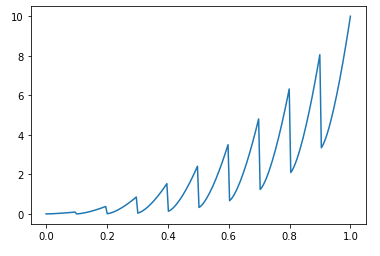
Create a jagged bpf between lowerbpf and upperbpf at the x values given
At each x in xs the, the value is equal to lowerbpf, sweeping with curvature 'curve' to upperbpf just before the next x
Example
from bpf4 import *
import numpy as np
a = expon(0, 0, 1, 10, exp=2)
b = expon(0, 0, 1, 5, exp=4)
j = util.jagged_band(list(np.arange(0, 1, 0.1)), a, b, curve='expon(1.5)')
j.plot()
Args
- xs (
list[float]): - upperbpf (
core.BpfInterface): - lowerbpf (
int): (default:0) - curve (
str): (default:linear)
loadbpf
def loadbpf(path: str, fmt: str = auto) -> core.BpfInterface
Load a bpf saved with dumpbpf
Possible formats: auto, csv, yaml, json
Args
- path (
str): the path of the saved bpf - fmt (
str): the format used to save the bpf ('auto' to detect the format) (default:auto)
Returns
(core.BpfInterface) a bpf
makebpf
def makebpf(descr: str, X: Sequence[float], Y: Sequence[float]
            ) -> core.BpfInterface
Create a bpf from the given descriptor and points
Args
- descr (
str): a string descriptor of the interpolation ("linear", "expon(xx)", ...) - X (
Sequence[float]): the array of xs - Y (
Sequence[float]): the array of ys
Returns
(core.BpfInterface) the created bpf
max_
def max_(elements) -> core.Max
Return a bpf representing the max over the given elements
Args
- elements: each element can be a bpf or a scalar
Returns
(core.Max) a Max bpf
maximum
def maximum(bpf: core.BpfInterface, N: int = 10) -> float | None
return the x where bpf(x) is the maximum of bpf
Args
- bpf (
core.BpfInterface): the bpf to analyze - N (
int): (default:10)
Returns
(float | None) is the maximum. Returns None if no maximum found
min_
def min_(elements) -> core.Min
Return a bpf representing the min over elements
Args
- elements: each can be a bpf or a scalar
Returns
(core.Min) a Min bpf
minimum
def minimum(bpf: core.BpfInterface, N: int = 10) -> float | None
Find the x where bpf(x) is minimized
Args
- bpf (
core.BpfInterface): the bpf to analyze - N (
int): the number of estimates (default:10)
Returns
(float | None) is minimized. Returns None if no minimum found
multi_parseargs
def multi_parseargs(args) -> tuple[list[float], list[float], list[str]]
Parse args of a multi bpf
Given a list of args of the form (x0, y0, interpol) or (x0, y0) (or a flat
version thereof), fills the possibly missing interpolation descriptions
and returns a tuple (xs, ys, interpolations)
Args
- args:
Returns
(tuple[list[float], list[float], list[str]]) a tuple (xs, ys, interpolations), where len(interpolations) == len(xs) - 1
parseargs
def parseargs(args, kws) -> tuple[list[float], list[float], dict]
Convert the args and kws to the canonical form (xs, ys, kws)
Raises ValueError if failed
All the following variants result in the same result:
x0, y0, x1, y1, …, exp=0.5
(x0, y0), (x1, y1), …, exp=0.5
{x0:y0, x1:y1, …}, exp=0.5
[x0, x1, …], [y0, y1, …], exp=0.5

Result: [x0, x1, …], [y0, y1, …], {exp:0.5}
Args
- args:
- kws:
Returns
(tuple[list[float], list[float], dict]) A tuple (xs, ys, kws)
parsedescr
def parsedescr(descr: str, validate: bool = True) -> tuple[str, dict]
Parse interpolation description
| descr | output |
|---|---|
| linear | linear, {} |
| expon(0.4) | expon, {'exp': 0.4} |
| halfcos(2.5, numiter=1) | halfcos, {'exp':2.5, 'numiter': 1} |
Args
- descr (
str): - validate (
bool): (default:True)
projection_fixedpoint
def projection_fixedpoint(rx, dx, offset) -> None
Returns the fixed point given the projection parameters
x2 = (x-offset)*rx + dx
For a fixed point, x2 == x
Args
- rx:
- dx:
- offset:
randombw
def randombw(bw: float | core.BpfInterface, center: float | core.BpfInterface
             ) -> core.BpfInterface
Create a random bpf
if randombw is 0.1 and center is 1, the bpf will render values between 0.95 and 1.05
Note
This bpf will always be different, since the random numbers are calculated as needed. Sample it to freeze it to a known state.
Example
>>> l = bpf.linear(0, 0, 1, 1)
>>> r = bpf.util.randombw(0.1)
>>> l2 = (l*r)[::0.01]
Args
- bw (
float | core.BpfInterface): a (time-varying) bandwidth - center (
float | core.BpfInterface): the center of the random distribution
Returns
(core.BpfInterface) a bpf
rms
def rms(bpf: core.BpfInterface, rmstime: float = 0.1) -> core.BpfInterface
The rms of this bpf
Args
- bpf (
core.BpfInterface): the bpf - rmstime (
float): the time to calculate the rms over (default:0.1)
Returns
(core.BpfInterface) a bpf representing the rms of this bpf at any x coord
rmsbpf
def rmsbpf(samples: np.ndarray, sr: int, dt: float = 0.01, overlap: int = 2,
           smoothen: float = 0.0) -> core.BpfInterface
Return a bpf representing the rms of the given samples as a function of time
Args
- samples (
np.ndarray): the audio samples - sr (
int): the sample rate - dt (
float): analysis time period (default:0.01) - overlap (
int): overlap of analysis frames (default:2) - smoothen (
float): if given, the returned bpf is smoothen using the given value as window (default:0.0)
Returns
(core.BpfInterface) a sampled bpf if not smoothening operation is performed, or a linear bpf if smoothening is required
select
def select(which: core.BpfInterface, bpfs: Sequence[core.BpfInterface],
           shape: str = linear) -> core._BpfSelect
Create a new bpf which interpolates between adjacent bpfs
Example
>>> which = nointerpol(0, 0, 5, 1)
>>> bpfs = [linear(0, 0, 10, 10), linear(0, 10, 10, 0)]
>>> s = select(which, bpfs)
>>> s(1)     # at time=1, the first bpf will be selected
0
Args
- which (
core.BpfInterface): returns at any x, which bpf from bpfs should return the result - bpfs (
Sequence[core.BpfInterface]): a list of bpfs - shape (
str): interpolation shape between consecutive bpfs (default:linear)
Returns
(core._BpfSelect) a BpfSelect
simplify_linear_coords
def simplify_linear_coords(xs: np.ndarray, ys: np.ndarray,
                           threshold: float = 0.0, ratio: float = 0.0
                           ) -> tuple[np.ndarray, np.ndarray]
Simplify the linear bpf defined by the points xs and ys
Args
- xs (
np.ndarray): the x coord array - ys (
np.ndarray): the y coord array - threshold (
float): the simplification threshold. Points which deviate less than this value will be simplified. The first and last points are never simplified (default:0.0) - ratio (
float): (default:0.0)
Returns
(tuple[np.ndarray, np.ndarray]) the simplified line as a tuple (xs, ys)
smoothen
def smoothen(b: core.BpfInterface, window: float, N: int = 1000,
             interpol: str = linear) -> core.BpfInterface
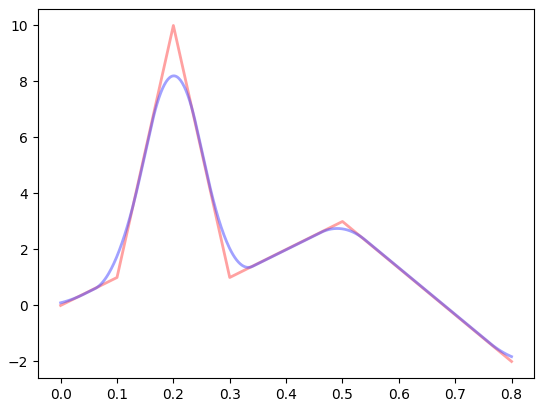
Return a bpf representing a smooth version of b
Example
>>> import bpf4 as bpf
>>> b = bpf.linear(0, 0, 0.1, 1, 0.2, 10, 0.3, 1, 0.5, 3, 0.8, -2)
>>> bsmooth = bpf.util.smoothen(b, window=0.05)
>>> axes = b.plot(show=False)
>>> bsmooth.plot(axes=axes)
Args
- b (
core.BpfInterface): a bpf - window (
float): the width (in x coords) of the smoothing window - N (
int): number of points to resample the bpf (default:1000) - interpol (
str): the interpolation to use. One of 'linear' or 'smooth' (default:linear)
Returns
(core.BpfInterface) a bpf representing a smoother version of b
split_fragments
def split_fragments(b: core.BpfBase, sep: float = nan) -> list[core.BpfBase]
Split a bpf into its fragments
Fragments are defined by the separator, which is NAN by default. This separator splits the points in this bpf into fragments. A fragment must at least have two items
Example
>>> a = bpf.linear(0, 0, 1, 10, 2, 5, 3, 30, 4, nan, 5, nan, 6, 0, 7, 1, 8, 0.5, 9, nan, 10, 2, 11, 3)
>>> split_fragments(a)
[Linear[0.0:3.0], Linear[6.0:8.0], Linear[10.0:11.0]]
Args
- b (
core.BpfBase): the bpf to split. This bpf must be a Linear, Sampled or any other BpfBase subclass (HalfCos, Smooth, etc.). For any other bpf the bpf needs to be sampled (bpf[::period]) - sep (
float): the separator to use (default:nan)
Returns
(list[core.BpfBase]) a list of bpfs representing the fragments
sum_
def sum_(elements) -> Any
Return a bpf representing the sum of elements
Args
- elements: each can be a bpf or a scalar
Returns
a bpf representing the sum of all elements
warped
def warped(bpf: core.BpfInterface, dx: float = None, numpoints: int = 1000
           ) -> core.Sampled
Represents the curvature of a linear space.
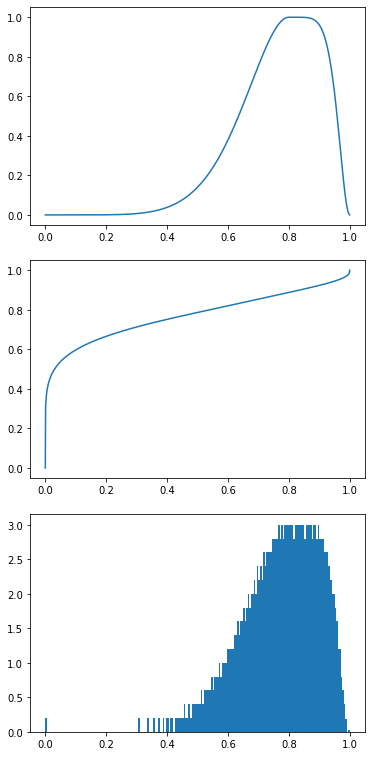
The result is a warped bpf so that:
position_bpf | warped_bpf = corresponding position after warping
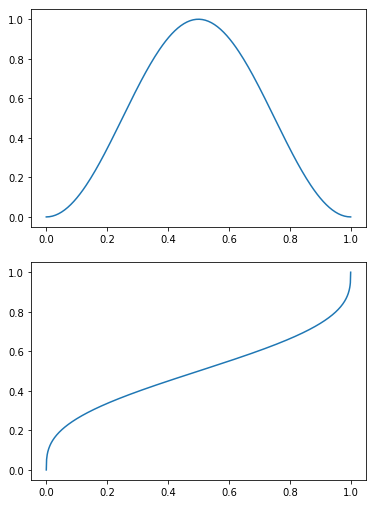
Example
Find the theoretical position of a given point according to a probability distribution
>>> from bpf4 import *
>>> import matplotlib.pyplot as plt
>>> distribution = halfcos(0,0, 0.5,1, 1, 0)
>>> w = util.warped(distribution)
>>> distribution.plot()
>>> w.plot()
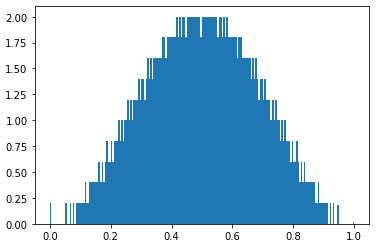
Now plot the histrogram of the warped bpf. It should resemble the original distribution
plt.hist(w.map(10000), bins=200, density=True)
Using another distribution, notice that the histogram follows the distribution again:
distribution = halfcos(0,0, 0.8,1, 1, 0, exp=3.)
w = util.warped(distribution)
distribution.plot()
w.plot()
_ = plt.hist(w.map(10000), bins=200, density=True)[2]
Args
- bpf (
core.BpfInterface): - dx (
float): the accuracy of the measurement (default:None) - numpoints (
int): if dx is not given, the bpf is samplednumpointstimes across its bounds (default:1000)
Returns
(core.Sampled) The warped bpf
zigzag
def zigzag(b0: core.BpfInterface, b1: core.BpfInterface, xs: Sequence[float],
           shape: str = linear) -> core.BpfInterface
Creates a curve formed of lines from b0(x) to b1(x) for each x in xs
   *.
    *...  b0
     *  ...
     *     ...
      *       ....
       *          ...
        *         :  ...
         *        :*    ...
         *        : *      ...
          *       :  **       ...
           *      :    *         :*.
            *     :     *        : **...
             *    :      *       :   *  ...
             *    :       *      :    *    ...
              *   :        *     :     **     .:.
               *  :         *    :       *     :**..
                * :          **  :        **   :  ****.
                 *:            * :          *  :      ****
    -----------  *:             *:           * :          ****
      b1       ---*--------------*---         **:             ****
                                     -----------*----------      .**
                                                           -----------
    x0            x1              x2                       x3
Args
- b0 (
core.BpfInterface): a bpf - b1 (
core.BpfInterface): a bpf - xs (
Sequence[float]): a seq. of x values to evaluate b0 and b1 - shape (
str): the shape of each segment (default:linear)
Returns
(core.BpfInterface) The resulting bpf